year 8 maths worksheets pdf
Year 8 maths worksheets in PDF format offer focused practice on key concepts, aligning with curricula like White Rose Maths and the British National Curriculum.
What are Year 8 Maths Worksheets?
Year 8 maths worksheets are specifically designed learning resources catering to students in the eighth year of their education, typically aged 12-13. These resources cover a broad spectrum of mathematical topics, building upon foundational skills and introducing more complex concepts. Commonly, they focus on areas like integers, number operations, expressions, equations, geometry – including area and volume – percentages, ratio, sequences, and standard form.
Available predominantly as PDF documents, these worksheets provide structured practice, often mirroring assessment styles used by educational programs like White Rose Maths. They aid in reinforcing classroom learning, identifying knowledge gaps, and preparing students for formal evaluations. The content is designed to align with the British National Curriculum, ensuring comprehensive coverage of essential mathematical skills.
Why Use PDF Worksheets?
PDF worksheets offer numerous advantages for Year 8 maths practice. Their universal compatibility ensures accessibility across various devices – computers, tablets, and smartphones – without formatting issues. This portability allows students to learn anywhere, anytime. Furthermore, PDFs are easily printable, facilitating offline practice and reducing screen time.
The format supports focused learning, minimizing distractions compared to interactive online exercises. Year 8 maths worksheets in PDF format are often designed for self-assessment, with answer keys provided separately. This promotes independent learning and allows students to track their progress effectively. They are also cost-effective, often available for free from resources like White Rose Maths or third-party providers, making quality education accessible to all.
Core Year 8 Maths Topics Covered
Year 8 maths worksheets commonly focus on integers, expressions, equations, geometry (area and volume), percentages, ratio, sequences, and standard form concepts.
Integers and Number Operations
Worksheets dedicated to integers and number operations are foundational for Year 8 students. These resources provide practice with positive and negative numbers, including addition, subtraction, multiplication, and division. A key focus is understanding the rules governing operations with negative numbers, a common area of difficulty.
Exercises often involve applying these operations to solve real-world problems, reinforcing practical application. Students will encounter questions involving order of operations (BODMAS/PEMDAS), fractions, decimals, and percentages, building a strong numerical foundation. Many worksheets also include practice with prime numbers, indices, and working with different types of numbers, preparing them for more advanced mathematical concepts. These skills are essential for success in subsequent topics.
Expressions, Formulae, and Equations
Year 8 maths worksheets focusing on expressions, formulae, and equations build algebraic skills. Students practice simplifying algebraic expressions by combining like terms and applying the distributive property. Worksheets cover forming expressions from worded descriptions, a crucial skill for problem-solving.
A significant portion focuses on constructing and manipulating formulae, often relating to geometric shapes (area, perimeter, volume); Solving linear equations – including those with variables on both sides – is a core component. These worksheets progressively increase in difficulty, introducing brackets and more complex manipulations. Understanding these concepts is vital as they form the basis for more advanced algebra in later years, preparing students for topics like linear graphs and functions.
Geometry: Area and Volume
Year 8 maths worksheets dedicated to geometry reinforce understanding of area and volume calculations. Students practice finding the areas of 2D shapes like rectangles, triangles, parallelograms, and circles – often incorporating the concept of Pi. Worksheets progress to calculating the perimeters of these shapes, solidifying spatial reasoning.
A key focus is extending these concepts into three dimensions. Students calculate the volumes of cubes, cuboids, and prisms. More challenging worksheets introduce composite shapes, requiring students to break them down into simpler components. These exercises build a strong foundation for future geometric studies, including surface area calculations and more complex 3D shapes, preparing them for higher-level mathematical concepts.

Specific Worksheet Categories
Year 8 maths worksheets PDF are categorized by topic, including percentages, ratio, sequences, standard form, circumference, and linear equations, for targeted practice.
Percentages and Ratio Worksheets
Year 8 maths worksheets focusing on percentages and ratio are crucial for developing proportional reasoning skills. These PDF resources typically cover finding percentages of amounts, percentage increase and decrease, and expressing quantities as ratios in various forms.

Worksheets often include problems requiring students to simplify ratios, divide quantities in a given ratio, and apply percentage calculations to real-world scenarios like discounts, taxes, and interest. Assessments, like those designed by White Rose Maths, frequently incorporate these concepts.
Practice with these worksheets builds a strong foundation for more advanced mathematical topics, ensuring students can confidently tackle problems involving proportional relationships and quantitative analysis.
Sequences and Patterns Worksheets
Year 8 maths worksheets dedicated to sequences and patterns help students develop algebraic thinking skills. These PDF resources commonly focus on identifying the rule in a sequence – arithmetic, geometric, or more complex – and using it to find subsequent terms.
Worksheets often present sequences as lists of numbers, diagrams, or real-life scenarios, challenging students to recognize the underlying pattern. They may also involve generating sequences from given rules or finding the nth term of a sequence.

Mastering these concepts is vital as they form the basis for understanding functions and algebraic expressions, frequently assessed in Year 8, as seen in White Rose Maths materials.
Standard Form Worksheets
Year 8 maths worksheets focusing on standard form (scientific notation) are crucial for handling very large or very small numbers efficiently. These PDF resources typically guide students through converting numbers between ordinary form and standard form (a x 10n).
Exercises often involve calculations – addition, subtraction, multiplication, and division – with numbers expressed in standard form. Worksheets may also present real-world applications, such as distances in space or the size of microorganisms, to demonstrate the relevance of this skill.
Developing proficiency in standard form is essential for scientific calculations and is a key component of the Year 8 curriculum, frequently appearing in assessments like those designed by White Rose Maths.

Advanced Year 8 Maths Concepts
Year 8 PDF worksheets extend learning to linear equations, graphs, circumference, and Pi, building upon core skills for more complex problem-solving abilities.
Circumference and Pi Worksheets
Year 8 maths worksheets focusing on circumference and Pi provide essential practice in calculating the distance around circles. These PDF resources typically include problems requiring students to apply the formula C = πd or C = 2πr, where ‘C’ represents circumference, ‘π’ (Pi) is approximately 3.14159, and ‘d’ and ‘r’ denote diameter and radius, respectively.
Worksheets often progress from basic calculations with given diameters or radii to more challenging scenarios involving finding unknown dimensions. Some may incorporate real-world applications, such as calculating the distance a wheel travels in one rotation. These exercises reinforce understanding of circular geometry and prepare students for more advanced mathematical concepts. Practice with these worksheets builds fluency and confidence in working with Pi and circumference.
Linear Equations and Graphs Worksheets
Year 8 maths worksheets dedicated to linear equations and graphs are crucial for developing algebraic skills. These PDF resources typically cover solving simple one-step and two-step equations, alongside introducing the concept of representing these equations graphically. Students practice rearranging formulas and isolating variables to find unknown values.
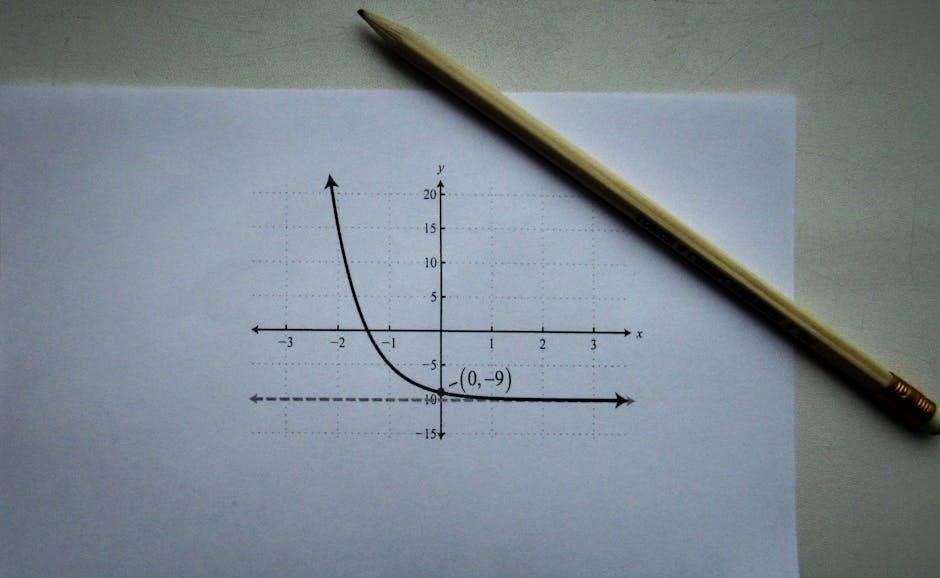
Worksheets often include exercises on plotting coordinate points, drawing straight-line graphs from given equations, and interpreting the slope and y-intercept. More advanced sheets may involve finding the equation of a line from a graph or solving simultaneous equations graphically. Mastering these concepts forms a foundation for further study in algebra and coordinate geometry, building problem-solving abilities.
Resources for Finding Worksheets
Year 8 maths worksheets (PDF) are readily available from White Rose Maths and various third-party providers, offering diverse practice materials for students.
White Rose Maths Year 8 Worksheets
White Rose Maths provides a comprehensive suite of Year 8 maths worksheets (PDF) designed to complement their popular scheme of learning. These resources are meticulously crafted by experienced educators and align directly with the national curriculum, ensuring thorough coverage of essential topics;
The worksheets often accompany their video lessons and are structured to build a strong foundation in areas like integers, expressions, geometry, percentages, and sequences. Assessments, also available, gauge student understanding of these core concepts.
Specifically, the assessment includes questions on percentages, ratios, sequences, standard form, circumference, and unit conversions. These materials are invaluable for both classroom use and independent study, supporting effective learning and skill development for Year 8 students.
Third-Party Worksheet Providers
Beyond White Rose Maths, numerous online platforms offer Year 8 maths worksheets (PDF). These providers often present a wider variety of question styles and approaches, catering to diverse learning preferences. Websites specializing in educational resources frequently host downloadable worksheets covering all core Year 8 topics, including number operations, algebra, geometry, and statistics.
While convenient, it’s crucial to evaluate the quality and alignment of these resources with the specific curriculum being followed. Look for providers offering answer keys and clear explanations to facilitate self-assessment and independent learning. Some platforms may require a subscription, while others offer free downloadable content.
Careful selection ensures students receive effective and relevant practice materials.

Tips for Using Year 8 Maths Worksheets
Year 8 maths worksheets (PDF) are most effective with consistent practice and focused review of challenging areas, aiding skill development and confidence.
Effective Practice Strategies
Utilizing Year 8 maths worksheets (PDF) requires a strategic approach for optimal learning. Begin with focused practice on specific topics, like percentages or linear equations, before mixing concepts.
Regular, short practice sessions are more beneficial than infrequent, lengthy ones. Encourage students to show their working clearly, identifying steps where they encounter difficulty.
Self-assessment is crucial; students should check their answers and revisit incorrect problems. Consider timed practice to build speed and accuracy.
Worksheets can also be used for collaborative learning, with students working together to solve problems and explain their reasoning. Finally, review completed worksheets to pinpoint areas needing further attention.
Identifying Areas for Improvement
Year 8 maths worksheets (PDF) are invaluable tools for pinpointing student weaknesses. Consistent review of completed worksheets reveals recurring error patterns – are mistakes concentrated in algebra, geometry, or number operations?
Analyze incorrect answers: is it a conceptual misunderstanding, a calculation error, or a problem with applying the correct formula? Encourage students to self-reflect on challenging questions.
Focus on topics where performance is consistently low. Utilize additional resources, such as online tutorials or textbook examples, to reinforce those concepts.

Targeted practice, using worksheets specifically designed for those areas, will accelerate improvement. Tracking progress over time demonstrates growth and builds confidence.

Printing and Accessibility of PDF Worksheets
Year 8 maths worksheets (PDF) are easily printable for offline practice, but ensure print quality is sufficient for readability and accessibility for all students.
Ensuring Print Quality
Printing Year 8 maths worksheets (PDF) requires attention to detail for optimal learning. Select appropriate paper quality – standard printer paper is usually sufficient, but heavier weight paper can improve durability. Always preview the print to confirm correct scaling; ensure the worksheet fits the page without cropping important information, especially diagrams or graphs.
Check your printer settings for resolution. A higher DPI (dots per inch) setting will produce sharper text and lines, crucial for geometric problems or equations. Black and white printing is generally adequate, but color can be beneficial for highlighting specific elements. Regularly maintain your printer to prevent faded or streaky prints, which can hinder student comprehension and accurate problem-solving.
Accessibility Features for Students
Year 8 maths worksheets (PDF) should be accessible to all learners. Utilize PDF readers with text-to-speech functionality for students with visual impairments or reading difficulties. Ensure sufficient contrast between text and background colors for improved readability.
Consider providing worksheets with larger font sizes or adjustable zoom levels. If possible, offer digital versions that allow students to fill in answers directly on the screen, benefiting those with motor skill challenges. Alternative text descriptions for images and diagrams are vital for screen reader users.
Finally, check for clear and concise language, avoiding overly complex phrasing that could hinder understanding for students with learning differences.
lec medical fridge instruction manual

iliotibial band syndrome stretches pdf